Showing posts sorted by relevance for query Mars. Sort by date Show all posts

Saturday, October 3, 2015

" The Waters of Mars."

Channels cut in the Martian surface as shot by NASA’s
Mars Reconnaissance Orbiter in 2011.
 
When the News story that (1)>> NASA was supposed to make a big announcement this week , I had a skeptical "ah ha" . I have heard this before . It's OLD NEWS for me , way out late . So is it exciting ?   NASA drummed up the idea that "life" was found on Mars. Leaving us guessing . It was close Yes,  (2)>>MARS HAS WATER on it's surface  ! It's a bit "briny" . How about having  a mixture of Chlorine , and acid . Sorry for my ridicule ,but NASA has known that Mars has water since the 1960's . Whatever what we might call "water" , it's not safe water for human consumption . As for "life" the implications of it might be astounding. That represents a shift in tone for NASA, where officials have repeatedly played down the notion that the dusty and desolate landscape of Mars could be inhabited today.But now, John M. Grunsfeld, NASA’s associate administrator for science, talked of sending a spacecraft in the 2020s to one of these regions, perhaps with experiments to directly look for life.  .FINDING  liquid water anywhere in the solar system is a huge deal, because the evidence for it has been so limited, and life as we know it depends on liquid water. "Follow the water" has been an astrobiological mantra. This may seem slightly narrow-minded, in that one could imagine alien life of a completely different chemical nature, but even the most imaginative thinkers, such as Carl Sagan, were water chauvinists and carbon chauvinists. Of course, this isn’t the first time water has been discovered on Mars. We know that water is laced within Mars regolith; we know there’s water locked in Mars’ ice caps and below the surface; we know that Mars once possessed rivers, lakes and even seas. The last few years of discoveries by our Mars orbiter, lander and rover armada have revolutionized our understanding of Earth’s smaller neighbor. But this time NASA’s Mars Reconnaissance Orbiter has made comprehensive measurements of what appear to be seasonal flows of liquid water on a global scale on modern Mars.Scientists have long known that large amounts of water remain — but frozen solid in the polar ice caps. There have been fleeting hints of recent liquid water, like fresh-looking gullies, but none have proved convincing.

What kind of "water" on Mars Today?
(1)>> I didn't watch the full press conference, but I did the read the paper, and I skipped to the part you said was relevant and was able to see the relevant frame from the video (my connection seems to be shitting out right now).They report absorption lines in Figure 1 at 1.4 microns and 1.9 microns, consistent with the presence of liquid water, but I think they have better spectroscopic evidence of perchlorate salts. These were taken from fourrecurring slope linnae (which were also photographed in the visible spectrum). RSLs are streaks that form on downhill slopes during the Martian summer.Water being found on Mars does not mean that you can just drink the stuff . First of all the Planet Mars has a  (4)>>vary low atmospheric pressure . As an example our Earth mean surface pressure based on barometric readings  as about 1036 MB ( Millibars) , the lowest is on Mt . Everest which has been measure at 29,000 FT as 300 MB . Even at 300 MB water is stable , but boils , since Mt. Everest is at 29,000 FT it's often a vapor or ice . So Lets go to Mars , all most all the scientific probes have  measured  the surface Mars pressures between 6 to 11 MB . It depends on location ,  surface depth . The lowest Martian pressure is on  (3)>> MONS OLYMPUS at 78 ,000 FT and its scarcely 1 MB . So what does this translate to ? First is that 11 MB on Mars is equivalence to being at 100,000 FT on Earth . A human being would need a Oxygen and pressure suit just to survive .  So anything that's a liquid , like human blood and water boil . So what we know today about Mars is that most of the water that exists is mostly frozen , or in a vapor state . We have seen water ice clouds on Mars on a balmy day , Mars has many kinds of clouds . Although Mars is smaller, at 11% of Earth's mass, and 50% farther from the Sun than the Earth, its climate has important similarities, such as the polar ice
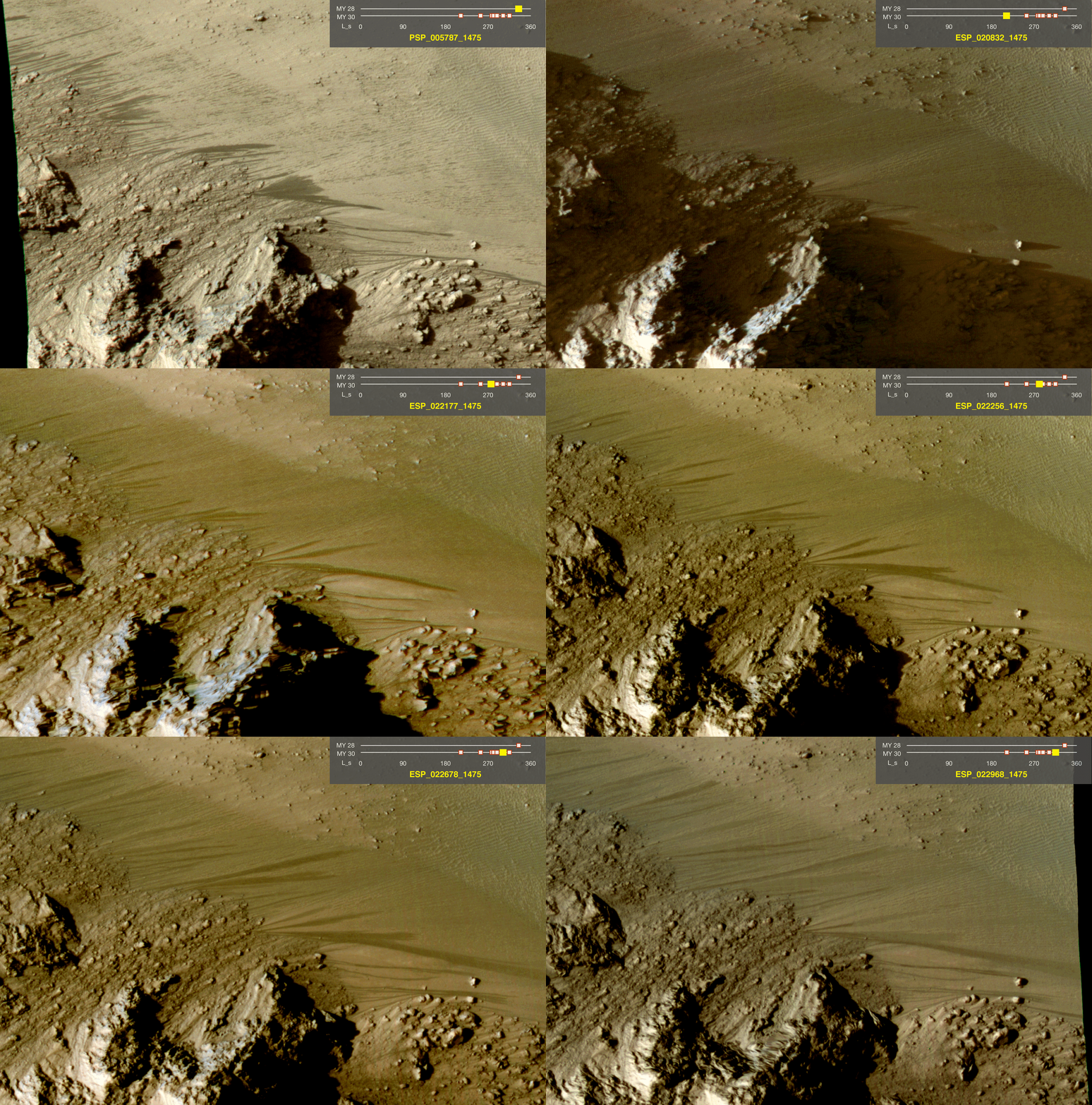
This intriguing image was taken by orbital probe HiRISE .Recurring slope lineae (RSL) are narrow (0.5-5 m), relatively dark markings on steep (25°-40°) slopes; repeat MRO/HiRISE images show them to appear and incrementally grow during warm seasons and fade in cold seasons.

caps, seasonal changes and the observable presence of weather patterns. It has attracted sustained study from planetologists and climatologists. While Mars's climate has similarities to Earth's, including seasons and periodic ice ages, there are also important differences, such as much lower thermal inertia. Mars' atmosphere has a scale height of approximately 11 km (36,000 ft), 60% greater than that on Earth. Mars' dust storms can kick up fine particles in the atmosphere around which clouds can form. These clouds can form very high up, up to 100 km (62 mi) above the planet.[14] The clouds are very faint and can only be seen reflecting sunlight against the darkness of the night sky. In that respect, they look similar to the mesospheric clouds, also known as noctilucent clouds on Earth, which occur about 80 km (50 mi) above our planet. Of course, we’re all excited about finding liquid salty water on the surface of Mars. But any prospects of sending a rover or even humans to study these mini "rivers" might have to be dampened (sorry), owing to issues of contamination.The dark streaks known as recurring slope lineae (RSL) all but confirmed liquid water is present on the surface. Such regions, though, are likely to be designated "Special Regions" by the Committee on Space Research (COSPAR). These are places where only a sterile lander would be allowed to visit as per planetary protection rules, keeping them safe from Earth microbes, and potentially ruling out manned missions or a rover like Curiosity. In April, scientists reported in the same journal that (5)>> perchlorate salts, like the ones in the new study, were "widespread" on the surface of our planetary neighbour and humidity and temperature conditions just right for salty
(6)>>brines to exist 
Martian weather and soil conditions that NASA's Curiosity rover has measured, together with a type of salt found in Martian soil, could put liquid brine in the soil at night .Perchlorate identified in Martian soil by the Curiosity mission, and previously by NASA's Phoenix Mars Lander mission, has properties of absorbing water vapor from the atmosphere and lowering the freezing temperature of water. This has been proposed for years as a mechanism for possible existence of transient liquid brines at higher latitudes on modern Mars, despite the Red Planet's cold and dry conditions.New calculations were based on more than a full Mars year of temperature and humidity measurements by Curiosity. They indicate that conditions at the rover's near-equatorial location were favorable for small quantities of brine to form during some nights throughout the year, drying out again after sunrise. Conditions should be even more favorable at higher latitudes, where colder temperatures and more water vapor can result in higher relative humidity more often..Finding life in hidden reservoirs beneath the crimson sands of Mars would be revelatory. If the biochemistry of these microbes was the same as ours, we would suspect that rocks from long ago carried their ancestors to Earth. And that would mean .But if not, if we find life that’s unrelated to ours, then we’ll know of two worlds that have spawned biology – and will confront the unavoidable fact that the universe is teeming with living things.  I hope we're able to find some kind of life there. thatd be amazing and completely change the course of human history. of course there is life out there somewhere but to find it so close to home would be pretty cool


NOTES AND COMMENTS:
(1)>>  NASA’s press statement makes it seem that scientists have certain evidence of flowing water. They do not. What they have is chemical evidence that gives a strong suggestion of liquid water mixed with salts. More importantly, however, even if NASA was 100% certain that there is liquid water on Mars, it could not do anything about it. (2)>> In a paper published in the journal Nature Geoscience, scientists identified waterlogged molecules — salts of a type known as perchlorates — on the surface in readings from orbit. Although Mars had rivers, lakes and maybe even an ocean a few billion years ago, the modern moisture is modest — small patches of damp soil, not pools of
standing water. (3)>>Olympus Mons. is a very large shield volcano on the planet Mars. By one measure, it has a height of nearly 25 km (16 mi).[3] Olympus Mons stands almost three times as tall as Mount Everest's height above sea level. It is the youngest of the large volcanoes on Mars, having formed during Mars's Amazonian Period. It is currently the largest volcano discovered in the Solar System and had been known to astronomerssince the late 19th century as the albedo feature Nix Olympica (Latin for "Olympic Snow"). Its mountainous nature was suspected well before space probesconfirmed its identity as a mountain. The typical atmospheric pressure at the top of Olympus Mons is 72 pascal, about 12% of the average Martian surface pressure of 600 pascals. Even so, high-altitude orographic clouds frequently drift over the Olympus Mons summit, and airborne Martian dust is still present.[17] Although the average Martian surface atmospheric pressure is less than one percent of Earth's, the much lower gravity on Mars increases the atmosphere's scale height; in other words, Mars's atmosphere is expansive and does not drop off in density with height as sharply as Earth's.(4)>> The Martian atmosphere is composed mainly of carbon dioxide and has a mean surface pressure of about 600 pascals (Pa), much lower than the Earth's 101,000 Pa. One effect of this is that Mars' atmosphere can react much more quickly to a given energy input than that of Earth's atmosphere.[38] As a consequence, Mars is subject to strong thermal tides produced by solar heating rather than a gravitational influence. These tides can be significant, being up to 10% of the total atmospheric pressure (typically about 50 Pa). Earth's atmosphere experiences similar diurnal and semidiurnal tides but their effect is less noticeable because of Earth's much greater atmospheric mass.Although the temperature on Mars can reach above freezing (0 °C (273 K; 32 °F)), liquid water is unstable over much of the planet, as the atmospheric pressure is below water's triple point and water ice sublimes into water vapor. Exceptions to this are the low-lying areas of the planet, most notably in the Hellas Planitia impact basin, the largest such crater on Mars. It is so deep that the atmospheric pressure at the bottom reaches 1155 Pa, which is above the triple point, so if the temperature exceeded 0 °C liquid water could exist there. (5)>> perchlorate. Perchlorate is, among other things, dangerous to the human body, capable of disrupting the basic functioning of the metabolic system. Mars also appeals because of the evidence of water we’ve found there, especially in the soil. The trouble is that water isn’t the only substance we’ve discovered in the dirt of Mars. In 2009, scientists responsible for the Phoenix lander reported that they had discovered a statistically significant sample of perchlorate within the soil of the “polygon-patterned northern plains of the Vastitas Borealis.” If you’re left wondering what on Earth this might mean, you’re not alone. One of the investigators would later claim that his team had to look up the substance to find out what, exactly, they’d discovered. (6)>>brines. Brine is a solution of salt (usually sodium chloride) in water. In different contexts, brinemay refer to salt solutions ranging from about 3.5% (a typical concentration of seawater, or the lower end of solutions used for brining foods) up to about 26% (a typical saturated solution, depending on temperature).Salt deposits over much of Mars indicate that brine was abundant in Mars's past.[11][17] Salinity lowers the freezing point of water to sustain a liquid flow. Less saline water would freeze at the observed temperatures.[11] Thermal infrared data from the Thermal Emission Imaging System (THEMIS) on board the 2001 Mars Odyssey orbiter, have allowed the temperature conditions under which RSL form to be constrained. Liquid brine flows near the surface might explain this activity, but the exact source of the water and the mechanism behind its motion are not understood.[23][24] A hypothesis proposes that the needed water could originate in the seasonal oscillations of near-surface adsorbed water provided by the atmosphere; perchlorates and other salts known to be present on the surface, are able to attract and hold water molecules from the surrounding environment (hygroscopic salts)

Monday, March 15, 2021

MUSK and MARS !

Maybe  for Elon Musk a 
human trip to Mars 
could be little 
unrealistic with 
current technology 
The thing about SpaceX getting money is that it comes from people who want things in return. People who want launches for conventional space purposes don't want to pay higher prices to subsidize  (1)>>Elon's Elon Musk must be CRAZY or he on to something . When it comes to the planet Mars , Musk have given a time line on when humans will walk on the red planet . He figures by 2023 his Space Ship X will put people on Mars . 
If SpaceX can in two or three years manage to launch Starships dozens of times per day, then 2026 isn't impossible. And if that happens, that means they can just send the equivalent resources that ISS consumes for two years on the trip. No ground breaking life support tech required but overstocking and redundancies enabled by massive payloads.  ON this post  I am going to tackle Musk's dream that with the "current technology " , any one government will be able to put humans on Mars . So while no country can just go to Mars or the moon and go “HA HA, THIS IS OURS NOW!,” the laws themselves on how operations work or are governed there are shockingly loose.  Even if  out right and Elon turns out wrong, the fact it's even conceivable is amazing and we are beyond privileged too live when we do.“If we don’t improve our pace of progress,  (2)>>"I’m definitely going to be dead before we go to Mars,” Musk said at the Satellite 2020 conference in Washington. “If it’s taken us 18 years just to get ready to do the first people to orbit, we’ve got to improve our rate of innovation or, based on past trends, I am definitely going to be dead before Mars.”I'm not trying to take away from what Musk has done on his own but I really hope he doesn't lose sight of how much help he received by the public and not go off on some ego trip about how it was only him in a sea of dissenting voices and only through his self determination and perseverance did Space X work.With legions of fans and detractors, is this entrepreneur a true automotive visionary or merely an electric-vehicle-peddling charlatan? Is he a genius or is he crazy? In just the last couple months, they finally appear to have sorted out the major woes plaguing Tesla Model 3 production, but Musk just had to give up being chairman following a run-in with the SEC over a tweet about taking the company private.  (3)>>Living on Mars isn't just a cool thing to do -- Musk has stated many times that establishing a colony on another world is the best way for mankind to avoid extinction.Here's a question I'd like to ask: extinction from what? Nuclear war? Ecological collapse? Asteroid strike? Or... something else...?Several months ago, Musk revealed that he invested in artificial intelligence startups so he could "keep up" with what's going on in that field.  (3.1)>>Musk has compared building computer programs exponentially smarter than any human to "summoning the devil".Think about what a hyper-intelligent computer program could do with tomorrow's world where everything is connected to the Internet Of Things. Could it crash every self-driving car connected to the web? Take over all the military drones in the world? Cause a meltdown in every nuclear power plant? Or, if it wasn't so grumpy, it could rewrite Wikipedia to assure us that everything's fine and that the cyber-demon secretly manipulating everything from the stock market to military satellites isn't real.Personally, I don't believe that a computer program can "think" and "reason" in the same way that humans can, so I'm not too worried about this. But if I'm wrong, and an exponentially-smarter-than-us A.I. comes into existence, letting it loose on the Internet would allow it to take over the world.

Technological Challenges to a Human Mars Mission .
Musk's Star Ship X 
has still to reach high altitudes ,
and safely land in
one piece .
Space travel is dangerous 
Mars , or anything to do with space exploration has its hazards. The moon is within reach of humankind, its really the easiest as demonstrated by the Apollo Program. Mars is father , much more distant even at it's closest approach , much more "dangerous" as in respect to our current technology . As for technology we have now , if you look at Musk's concepts they are pure 1960 tech  . Anything going to Mars is going to require a Star Trek type technology. A space ship with a crew of 20 men and women , a ship large enough to carry oxygen , food, water  . The space ship alone has to use some kind of nuclear power engine rather than a chemical  
propulsion engine . 
NASA's human Mars mission presents even more challenges of sending humans safely to a farther distance and to a more dangerous environment. Designing an aircraft that can safely enter and exit Mars' unpredictable atmosphere is a big challenge.    (3.2)>>An independent report concluded that NASA has no chance of sending humans to Mars by 2033, with the earliest such a mission could be flown being the late 2030s.NASA Administrator Jim Bridenstine told the United States Senate Committee on Commerce, Science, and Transportation that there is a path to reach Mars by 2033, contradicting an earlier independent report that found that timeline unfeasible. (4)>>The BIG QUESTION has to be technological development by 2033 . Musk with Space X could develop a reusable large payload launcher . Beyond that Space X rocket couldn't get to Mars in one long shot . Science & Technology Policy Institute was deeply critical of the timeline established by the administration of President Donald Trump for reaching Mars. The institute stated that any further delays would realistically push the launch date back to 2039.The report’s authors wrote, “We find that even without budget constraints, a Mars 2033 orbital mission cannot be realistically scheduled under NASA’s current and notional plans. Our analysis suggests that a Mars orbital mission could be carried out no earlier than the 2037 orbital window without accepting large technology development, schedule delay, cost overrun, and budget shortfall risks.” The achievable trip times (within given delta-v and maximum reentry velocity) also varies enormously with the specific transfer window, so this might just be about being conservative.Or to put it another way, in favorable transfer windows a 3 month transfer should be very doable, but a 6 month transfer is possible in any transfer window, while the 3 month transfer might be close to impossible in an unfavorable window.I seem to recall (may be recalling wrongly) that the arrival velocity was actually a greater constraint in "unfavorable" windows than the departure delta-v, essentially  (5)>>it's not too hard to intercept Mars, but the transfer orbit and the orbit of Mars cross at a rather severe angle rather than being nearly tangential. So the most important thing for very quick transfers (especially in unfavorable windows) would be an amazing heat shield, though g-forces also do become problematic, as with the 7500 m/s entry we're looking at peak g-forces of something like 5 g, and an arrival at something like 10000 m/s would increase that to something like 8 g.We are talking timelines of developing a SpaceX NTR.  (6)>>This is next generation Starship territory. The diameter can change. The volume ratio of propellant tanks to cabin can change. If you're going full fast transfer the ship is going to get optimized for that. Larger diameter ship goes well with needing to handle faster entry. Part of entry heating scales with radius of curvature in addition to ballistic coefficient.It could also pair with a pusher stage. A Starship that has Hydrogen NTR propulsion that is pushed by another Starship tug (Normal propulsion bus, but a booster/ship interface on top instead of fairing) is a great fit. The lower mass of the H2 prop pays off in letting the Methalox stage toss it to a decent Earth escape velocity before braking back to orbit. Now you have the NTR full with all deltaV for speeding up the transfer. This architecture can be done all Methalox, but it doesn't do nearly as well because the pusher stage is tossing a full 1200 metric ton prop load Starship . Such a starship would be capable of sending humans to Mars , but it must be a multi-crew of international astronauts , men and women .

MARS at a Glance .

Somewhat "Earthlike" but
hazardous planet Mars 
in all glory .

 (7)>>
Next to Earth, Mars is the most habitable location in the solar system (by terrestrial standards). Multiple lines of evidence accumulated over the course of decades have also shown that it may have supported life at one time. Unfortunately, sending astronauts to Mars will inevitably entail a number of distinct challenges, which arise from logistics and technology to  and the distances involved.
It's not about technology. It's that Mars isn't a viable option. It's size makes for a weaker magnetic field, meaning less protection from solar radiation. Between this and the lesser gravitational pull, Mars can't sustain the kind of atmosphere we have on Earth.Mars can sustain an Earth-like atmosphere, we'd just have to replenish it or it'd dissipate over time. Venus has an atmosphere significantly thicker than Earth's and also has almost no magnetic field.Creating a self-sustaining atmosphere on Mars would probably involve mining ice on planet to thicken the atmosphere up, or bringing in icy asteroids to mine in orbit. Break them up into small bits and send them into the atmosphere at a constant rate and the atmosphere dissipation wouldn't be an issue. Of course, the infrastructure to do that doesn't really exist yet, nor would it really be technically practical at this point either. 
With the recent landing of the rover on Mars its made me think: DO I want to live on Mars. I want to colonize it. I know it will be incredibly tough, it will be hellish, it will probably bring a sane man to the brink of insanity, but I'm willing to take the challenge, willing to take the risk. Imagine 50 years from now when there's ~1000 people on Mars. (8)>>Living on Mars is really a piece of fiction , with a long history .  Examples like TOTAL RECALL of the film sake , with human colonies , and  a so called "tourism industry shuttling people between planets might take a thousand years . Imagine taking strong, healthy and fit humans and send them to the International Space Station for a year. When they come back they are unable to get up and require physiotherapy to learn to walk again. Every time you set foot on the ground, nerve cells on the soles of your feet send a signal to the brain, reminding it that bones are very important. Weightlifting does increase the pressure on your feet and can lead to greater bone density. Conversely, staying for a long time in micro-gravity will cause you to lose bone and muscle mass. Now imagine travelling to Mars for several months, going through a very dangerous landing because of a very thin atmosphere and then be stuck there. There is no one to come and help you out of the landing module. You better be able to get up or your colony will be short-lived. On the other hand, you will have the advantage that the gravity is about 1/3 that of earth.Let's say that this part goes well. If the idea is to colonize (9)>>Mars then people will need to reproduce there. It is totally unclear whether humans can successfully conceive and gestate in 1/3 earth's gravity. If adults lose bone and muscle mass, it is not a safe bet that the skeleton and musculature of an embryo will develop properly. Whether or not it's possible to have children in the Martian environment is still unknown. Humanity has fantasized about moving offworld since time immemorial, or at least since we realized we were part of something much larger than just this rocky sphere. But there are also real ethical, legal, biological, sociological and psychological considerations at play.  I will look back and think "I set the foundation for this new frontier." I will set the footwork for people to want to discover new habitable planets. If there's a complication and my crew and I encounter a fatal event, I will still know that I set foot were only several decades ago, living on a planet other than earth, was impossible. I will be a pioneer, a pioneer of the future. It fills me with joy just writing about it. I hope others share the same fascination, and I hope there's still a future the human species.


NOTES AND COMMENTS:
(1)>>Elon's Elon Musk must be CRAZY or he on to something .  My personal theory is he wants to colonize Mars because the first baby born on Mars is a sovereign citizen of that planet and gets to rule it. Musk has the Bond villain mentality, but unlike Bond villains; he's working smarter not harder. Instead of trying to take over the world, he's starting fresh on a new world. He'll ensure his offspring will be the first born there, and his legacy will be the ruling class.  I have no doubt that they can put a ship on Mars by then, but sending a manned ship that far, and landing it (presumably with them still alive) is a bit harder. All of the closed system recycling for food and water for long duration, the protection from radiation, all of that sort of stuff is still in early stages.I guess if they build something in orbit, in stages, and make it large enough to carry all those supplies rather than recycling them or growing them on the way, then it may be more achievable. But I don't think that our technologies to keep humans alive for even 6 months are advanced enough unless they are confident about getting, and using, some significant resources (especially water/ice to provide both drinkable water and oxygen) from Mars itself. And right now, that is certainly possible, but unproven.  (2)>>"I’m definitely going to be dead before we go to Mars,”    Musk's forecast came in response to a question about how he's passing his vision along to the next generation of space explorers. "I hope I'm not dead," Musk said, before acknowledging that he's not confident humans will complete a mission to Mars while he's still alive without improving the current rate of innovation.The biggest technological obstacle, according to Musk, is building a reusable rocket with enough capacity to carry the things humans would need on a Mars mission."There's really just one thing that matters, and that is a fully and rapidly reusable rocket," Musk said, adding that "it needs to be reasonably big."Musk’s plan is as ambitious as it is grand: if all goes according to plan, he wants to establish a one million people-strong city on the Red Planet as soon as 2050 using a fleet of Starships.And such a city “has to survive if the resupply ships stop coming from Earth for any reason whatsoever,” Musk told Ars Technica “Doesn’t matter why. If those resupply ships stop coming, does the city die out or not?”(3)>>Living on Mars isn't just a cool thing to do --- Concepts of crewed Mars missions take about six months for between three and six astronauts to reach the planet, along with a few dozens of tons of consumables. Although it may be possible for some resources to be obtained from Mars—carbon dioxide from the atmosphere, water ice from the soil to produce oxygen and organic compounds, hematite to produce iron, silicates to produce glass—we’re decades away from understanding if any of that would be practically possible. Relative to Earth, the air on Mars is extremely thin. Standard sea-level air pressure on Earth is 1,013 millibars. On Mars the surface pressure varies through the year, but it averages 6 to 7 millibars. That's less than one percent of sea level pressure here. To experience that pressure on Earth, you would need to go to an altitude of about 45 kilometers (28 miles). (Yes, you'll need a space suit to walk around on Mars.) The Martian surface pressure also varies due to elevation. For example, the lowest place on Mars lies in the Hellas impact basin, 7.2 km (4.4 mi) below "sea level." The pressure there averages about 14 millibars. But on top of Olympus Mons, 22 km (14 mi) high, the pressure is only 0.7 millibar. In addition to dust storms, Mars has clouds made of both water ice and CO2 ice particles. Scientists have studied these from orbit with spacecraft, from the ground with rovers and landers, and from Earth with big telescopes. Clouds collect near the large volcanoes as winds rise over them and ice particles condense. In winter, clouds also form over the polar regions as broad hazes that scientists call polar hoods.Future Mars exploration missions will present scientists and astronauts alike with a host of problem that will challenge human survival. Accessing water, dealing with a frigid planet that lacks oxygen and coping with dangerous levels of radiation are among the biggest hurdles to overcome. But as humans persists toward the moon with an eye on Mars, they will learn to adapt, as they always have, and find new solutions to the problems facing them over the next horizon.(3.1)>>Musk has compared building computer programs exponentially smarter than any human to "summoning the devil".Elon Musk told Bloomberg’s Ashlee Vance, the author of the biography Elon Musk, that he was afraid that his friend Larry Page, a co-founder of Google and now the C.E.O. of its parent company, Alphabet, could have perfectly good intentions but still “produce something evil by accident”—including, possibly, “a fleet of artificial intelligence-enhanced robots capable of destroying mankind.” In September 2017, the SpaceX and Tesla CEO even said that competition for A.I. superiority among countries such as China or Russia could lead to World War III. He explained that he was not just concerned about the prospect of a world leader starting the war, but also of an overcautious A.I. deciding “that a [pre-emptive] strike is [the] most probable path to victory”. The possibility of developing autonomous, robotic, lethal weapons does not scare only Musk, however. Thus, we believe that Elon Musk’s fears about the development of A.I. being „summoning the devil” are way too exaggerated. However, while the technology has much potential for transforming society, the latest positive attitudes might also be inflated. The best potential pair is a human with technology. This is the only balance that can lead to a positive future with more and more disruptive innovations including everimproving cognitive computing but also ever-improving human intelligence and wisdom.   (3.2)>> An independent report see [👉👉 https://www.ida.org/-/media/feature/publications/e/ev/evaluation-of-a-human-mission-to-mars-by-2033/d-10510.ashx ]  while completed prior to the March 26 speech where Vice President Mike Pence directed NASA to return humans to the moon by 2024, does offer insights into how much a lunar return might cost and how it fits into long-term plans to send humans to Mars.(4)>>The BIG QUESTION has to be technological development by 2033 . In 2033, human potentiality will widen more. It will be a future where a person can live without any restrictions by pursuing only the creativity that is innate in humans. Machines can do much more to unleash human potential.Together with machines, human can experience more joy in their lives. Mission success of a landing, on the moon or other body, depends on the productivity of astronauts or robotic explorers deploying instrumentation and collecting scientific samples in the surroundings of their landing sites. (5)>>it's not too hard to intercept Mars. But keep in mind that when it comes to human missions to Mars, NASA’s “preparation” has already lasted quite a while: the last 70 years straight.The delay is at least in part technical. A trip to the red planet is like visiting an even more inhospitable Antarctica, and its unbreathable atmosphere is less than two percent of what you’d find at Everest’s summit. Never mind the fact that you have to fly at least a year, round-trip, to get there in the first place.(6)>>This is next generation Starship territory.  Going to MARS requires a interplanetary space ship that has to be assembled in Earth orbit. There are several parts to this question. First, the questioner asks why they building three new ships: Orion, Crew Dragon, and CST-100 Starliner? Crew Dragon and Starliner (from SpaceX and Boeing, respectively) are transport ships from Earth to low Earth orbit destinations, including the ISS. Their life support systems and heat shields cannot handle extended deep space conditions or survive reentry at reentry speeds of 25,000+ mph (vs. 17,500 mph from low Earth orbit). NASA is contracting to use these ships for astronaut trips to ISS, but SpaceX and Boeing want other customers, like tourists and industrial firms, too. The companies are contributing around half of the development costs in partnership with NASA.Orion and the Space Launch System are designed for taking four-person crews to the Moon’s vicinity. Orion has three times the internal living space of Apollo, can support the crew during a month-long mission in deep space, and has a heat shield capable of interplanetary reentry, where temperatures are 5,000 degrees F vs. the 3,000 degrees experienced by low Earth orbital craft. The SLS requires more takeoff power than the Saturn V moon rocket because it must launch the heavier, larger Orion, with its life support supplies and rocket propellants, to the Moon or beyond.(7)>>Next to Earth, Mars is the most habitable location in the solar system.  The Moon and Mars are without exception could be considered "habitable" in NAME ONLY . Humans will have to live with artificial means , somehow like STAR TREK produce artificial gravity .  AI SpaceFactory, an architecture and technology design agency that specializes in designing and 3D printing Martian habitats. The company recently competed in and won NASA's 3D-printed habitat challenge with a design called Marsha for examples. Mars X House’s exterior is dotted with small windows that would give astronauts a connection to the outside world, while providing some small exposure to sunlight to help keep their circadian rhythms on track while in space. Terraforming Mars would be a long shot , but difficult . The researchers suggest that regions of the Martian surface could be made habitable with a material — silica aerogel — that would mimic Earth’s atmospheric greenhouse effect. Through modeling and experiments, the researchers show that a 2- to 3-centimeter-thick shield of silica aerogel could transmit enough visible light for photosynthesis, block hazardous ultraviolet radiation, and raise temperatures underneath permanently above the melting point of water, all without the need for any internal heat source. This would take hundreds of years to achieve any kind of climate change on Mars.(8)>>Living on Mars is really a piece of fiction , with a long history . Prior to the scientific community’s brushing-off of this concept, another French astronomer, Camille Flammarion, wrote several works that would today be considered sci-fi novels. In one of these, Les Terres du Ciel (1884), Flammarion describes the scenery of bodies such as the moon and Mars to his readers. Flammarion’s interest in the moon may have been sparked by the 1865 novel by his fellow countryman Jules Verne, From the Earth to the Moon.  Around 1898, a mere three years after the publication of Percival Lowell’s first Martian book, H.G. Wells’s epic sci-fi classic The War of the Worlds was published. The story he tells is one of invaders from Mars coming to Earth and leveling cities with their destructive lasers. Humanity retaliates with what it can, but the Martians’ tech is too advanced and efficient. It is fitting that the Earth finds itself in a desperate fight with the inhabitants of Mars, the name for the ancient god of war. The War of the Worlds enjoyed a host of Hollywood film adaptations. It was also converted into a radio play in 1938, late in the Great Depression, and was broadcast and narrated by Orson Welles. His realistic rendition and delivery of the script famously caused a panic throughout the U.S.  Carl Sagan said in his 1980 book Cosmos: “Mars has become a kind of mythic arena onto which we have projected our Earthly hopes and fears.”  (9)>>Mars then people will need to reproduce there. Do I even need to talk about inbreeding? You could prevent those problems by sending enough humans to Mars but of course that only makes the logistics even harder and more expensive.Conceiving on Mars will be an experiment. We don't know what will happen: miscarriage, baby born in terrible pain, baby born deformed? How can we ethically justify doing that experiment?


Thursday, November 28, 2013

The "Politics" of Mars Exploration.

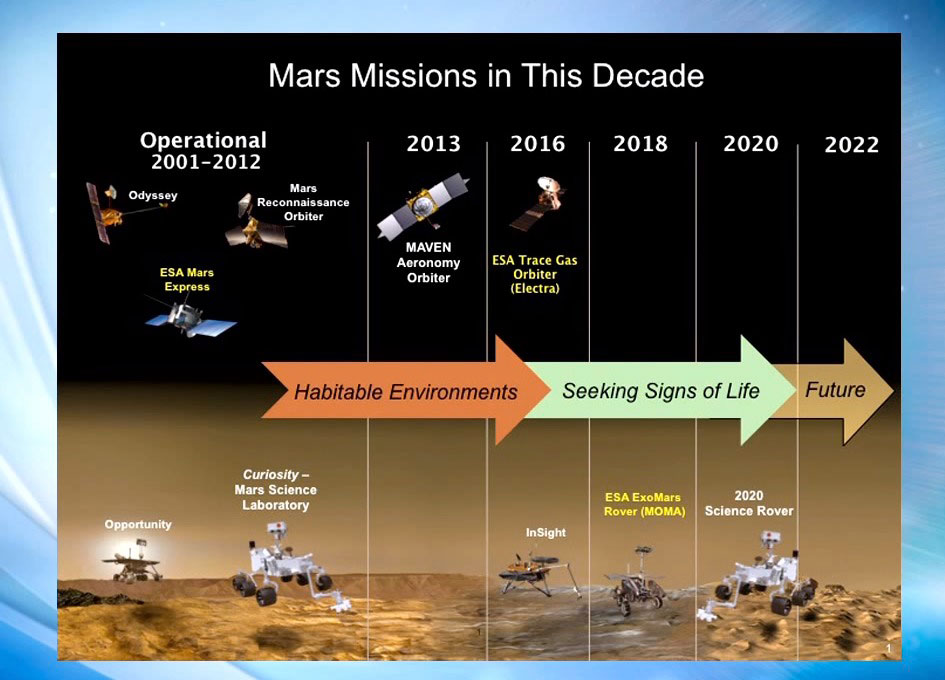
There have been more robotic missions to Mars in this last decade than there have been . I was thinking to write a  piece about Mars , the planet.  In a political sphere Mars exploration is costly to American nationalism , but lets  figure on this since 1976 we landed on Mars beginning with Viking 1 and Viking 2 We have analyzed the soil , the air . We have "discovered"  that Mars was "earth-like" in some distant past , with orbital photo's of dry river beds , channels and ocean-like coastlines . My ARGUMENT is why is the United States sending more probes and rovers , have we learned already about Mars is a bit intriguing .Mars has lots of water and so on . The newest Mars probe called MAVEN successfully sneaked through its weather window and launched from Cape Canaveral . Blasting away to join 20 other orbiting human made satellites . NASA's MAVEN is basically has nothing "new" as far as instrumental , it is an "atmosphere" probe . What get's me is , and it draws a line for "conspiracy kooks" is that NASA/ Government must have "discovered" something on Mars already to account for it's massive spending for Mars projects . NASA has planed for future Mars missions that will include a sample return mission . Is NASA covering up evidence of life on Mars? That’s what University of Cardiff astrobiologist Chandra Wickramasinghe claims as quoted in an article on the Helium website (warning: site has autoloading video ads) Professor Chandra Wickramasinghe, acclaimed astrobiologist from Cardiff University of Wales said the discovery of water on planet Mars combined with other discoveries point to the existence of life on the planet. In an interview he said, “The discovery of liquid water on Mars combined with earlier discoveries of organic substances in a meteorite that came from Mars, and also of methane in the Martian atmosphere all point to the existence of life – contemporary life – on the “Red Planet”. “I am not speaking of fossilized life but contemporary life,” he emphasized. Professor Wickramasinghe , is the world’s leading proponent of Panspermia, which suggests that all planets including earth in the universe have been seeded for life by microbes from outer space. He recently said such life could even exist on the upper layer of the clouds of Venus and could be blown out to earth by solar wind. Professor Chandra Wickramasinghe and Dr Janaki Wickramasinghe (his daughter) of the Cardiff Astrobiology Center claim that Venus’s clouds contain chemicals that exist with the presence of micro organisms. “Our research proposes that the two sisters, Earth and Venus may be biologically interconnected as well,” Wickramasinghe added. Speaking of earth’s other sister planet Mars, Chandra Wickramasinghe said, “ Even as early as 1976, when the two NASA space probes “Viking 1 and Viking 2” landed on Mars, experiments carried out in situ pointed strongly to the existence of active microbial life. In one experiment nutrient broth was poured onto a sample of Martian soil, and it frothed up so vigorously exuding carbon dioxide, that a positive detection of life might have been inferred. But when the NASA scientists looked for organic material, the detritus of living organisms, around the landing site, their experiments yielded negative or ambiguous results. So NASA cautiously concluded – no organics means no life detected. But 32 years on,  Gil Levin, who was Principal Investigator on this project maintains that life on Mars was indeed detected in 1976! The experiments of 1976 to detect the dead bodies and decomposition products of bacteria were simply not sensitive enough.” > So I have argue . No wonder the United States has invested so much on a Mars exploration missions , yes its not admitting that it "found" life on Mars as of yet . Yet in the scientific community there is a fringe group of NASA scientists who are willing to accept that the  Red Planet  is alive and well.

NOTES AND COMMENTS:

The biggest "riddle" of possible Mars life has been the recent detection of Trace amounts of methane (CH4), at the level of several parts per billion (ppb), were first reported in Mars's atmosphere by a team at the NASA Goddard Space Flight Center in 2003.[3][25] In March 2004 the Mars Express Orbiter[26] and ground based observations from Canada–France–Hawaii Telescope[27] also suggested the presence of methane in the atmosphere with a mole fraction of about 10 nmol/mol.[28] Because methane on Mars would quickly break down due to ultraviolet radiation from the Sun and chemical reactions with other gases, its reported persistent presence in the atmosphere also necessitates the existence of a source to continually replenish the gas. Current photochemical models alone can explain neither the fast appearance nor the disappearance of the methane, or its reported variations in space and time.[29] It had been proposed that the methane might be replenished by meteorites entering the atmosphere of Mars,[30] but researchers from Imperial College London found that the volumes of methane released this way are too low to sustain the measured levels of the gas.[31]The methane occurs in extended plumes, and their profiles imply that the gas was released from sources in three discrete regions. In northern midsummer, the principal plume contained 19,000 metric tons of methane, with an estimated source strength of 0.6 kilogram per second.[32][33] The profiles suggest that there may be two local source regions, the first centered near 30°N 260°W and the second near 0°N 310°W .[32] It is estimated that Mars must produce 270 tons/year of methane.[32][34][35] The existence of life in the form of microorganisms such as methanogens is among possible, but as yet unproven sources. If microscopic Martian life is producing the methane, it likely resides far below the surface, where it is still warm enough for liquid water to exist.[22]Since the 2003 discovery of methane in the atmosphere, some scientists have been designing models and in vitroexperiments testing growth of methanogenic bacteria on simulated Martian soil, where all four methanogen strains tested produced substantial levels of methane, even in the presence of 1.0wt% perchlorate salt.[102] The results reported indicate that the perchlorates discovered by the Phoenix Lander would not rule out the possible presence of methanogens on Mars.[102][103]
Exactly! Why cover it up? If NASA had proof of life anywhere, they would suddenly find they had funding for new missions. Even if they did cover it up, why continue when their funding gets slashed, the JIMO mission canned? That would be the time to come out.

Interestingly enough INDIA is also launching a space craft to Mars .  India’s Mars Orbiter Mission (MOM) is any indication (see above), then we can expect absolutely gorgeous scenes of the Red Planet once the groundbreaking probe arrives there in September 2014. But despite all that’s been accomplished so far, the space drama is still in its infant stages – because MOM still needs to ignite her thrusters this weekend in order to achieve escape velocity, wave good bye to Earth forever and eventually say hello to Mars!